Archive | travel RSS feed for this section

8th Bird of Christmas: Crested Caracara

2 Jan

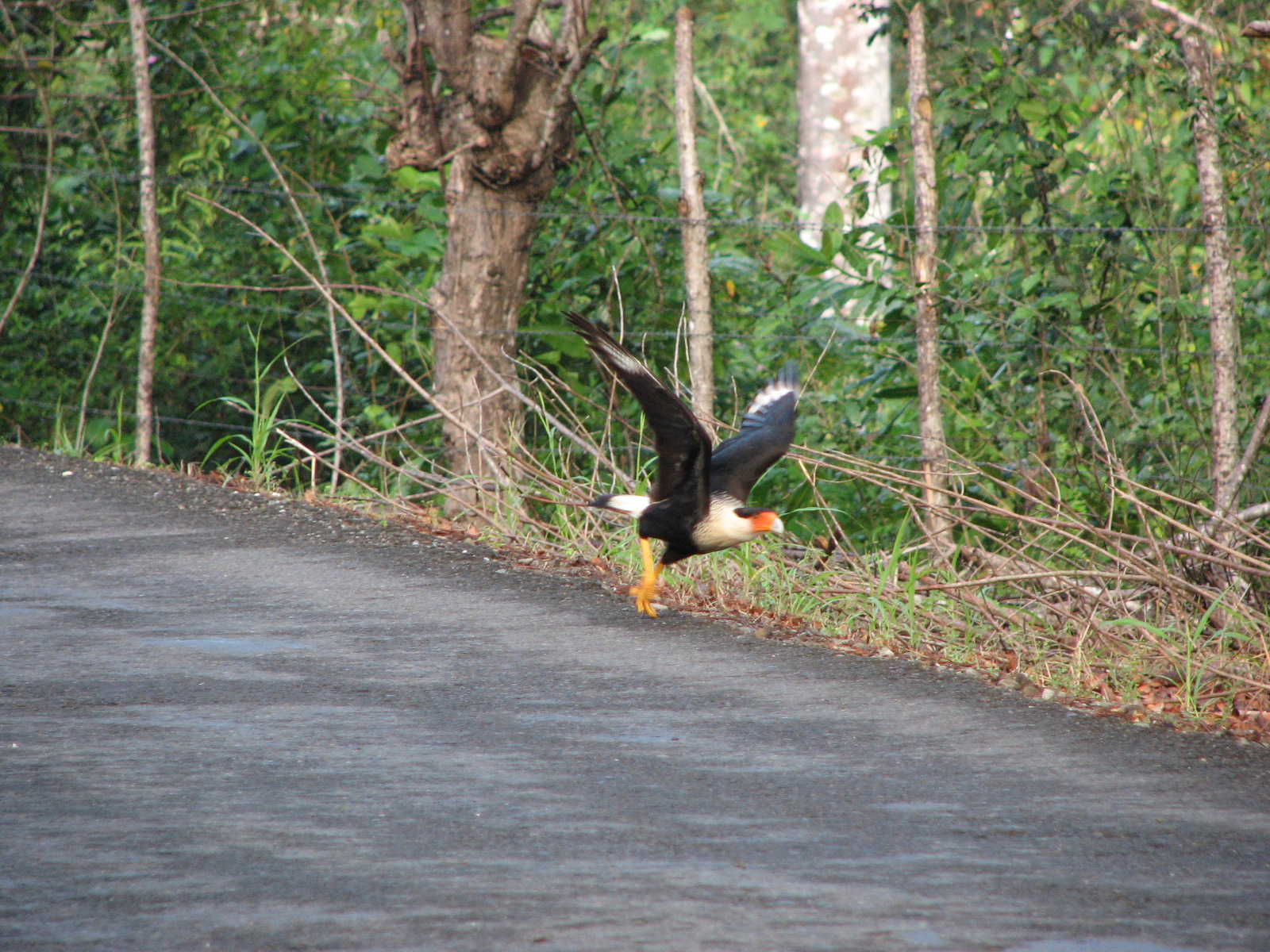
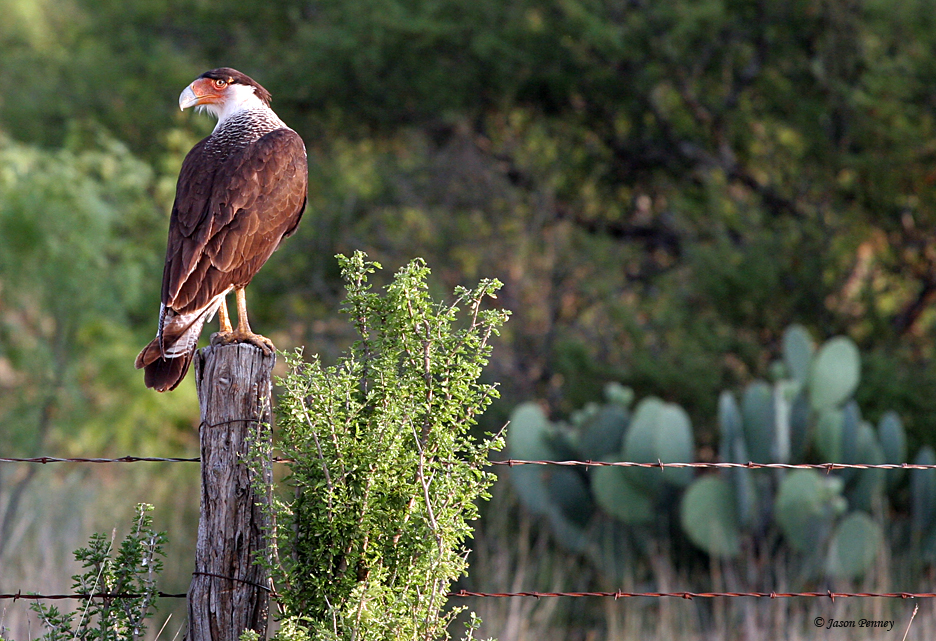
Today’s bird follows nicely on the heels of yesterday’s – it’s another falcon, but it is more a scavenger and less a predatory species than the Guaco. Seeing this chicken-like raptor that frequents roadways where it can find carrion efficiently always reminds me of one specific incident which begs the question: “Which came first, the car or the Caracara?”

Photo by Bruce Smith

Like many people, I went to Costa Rica initially to experience ecotourism and the resorts and parks that make sustainable practices their focus. The incredible abundance and diversity of plants and trees there in turn support an incredible abundance and diversity of wildlife, which is what makes the country such an amazing ecotourism destination.

Ticos realized the need to protect their country’s natural resources as early as the 1850s. A century later, a commission was created to study places in the country that should be declared national parks and by 1970, the first parks were established to protect the flora and fauna that make this destination so special. Thus Costa Ricans seem to have a true understanding of how important animals are to their economy – alive rather than dead.

Photo courtesy J Centavo.

Given this history of environmental consciousness, I was amazed to witness every single day I lived in Costa Rica, no matter where I went, an insidious threat to animal life in the form of speeding vehicles.

One day I was walking along the gravel road that leads into Curu Wildlife Refuge, when a taxi sped by me so fast it nearly hit me and a couple of horses. Five minutes later, having picked up a customer at Curú’s Information Center, it raced back down the park road at equally dangerous velocity, this time threatening a Crested Caracara to within an inch of its life. At the expense of any life (wild or otherwise) that happened to be in the way, this tourist was going to get to her next ecotourism activity or hotel muy rapido!

Mexico’s national bird, and found in the southern US, Caracara cheriway combines many characteristics of other species, simultaneously resembling a hawk, vulture, chicken and roadrunner. Called “the bone carrier,” cargahuesos in Spanish, it perches on a low branch, walks around on the ground, or glides low to the earth with wings crooked and bowed, showing the white patch at the base of its primaries. Cruising above roadways in search of roadkill, it occasionally takes live prey or pirates prey from other birds, especially vultures. Vocalizations are dry rattles that give it the moniker “caracara.”

One solitary hike found me face to face with a juvenile who seemed merely bemused by my capturing many photos while he or she preened and looked unconcerned. I could never figure out why this young individual seemed to have an egg actually attached to its chest just under the feathers, which you can see in these photos. If anyone knows the answer to this mystery, please chime in. A tumor perhaps?

So, to return to the question, “Which came first, the car or the caracara?” I think we know the answer. This road running raptor will always be a reminder to me that wherever we go on this planet, there will be cultural challenges and social mores with which we will not agree, but to which we’ll of necessity adapt with cautious tolerance.

7th Bird of Christmas: Laughing Falcon

1 Jan

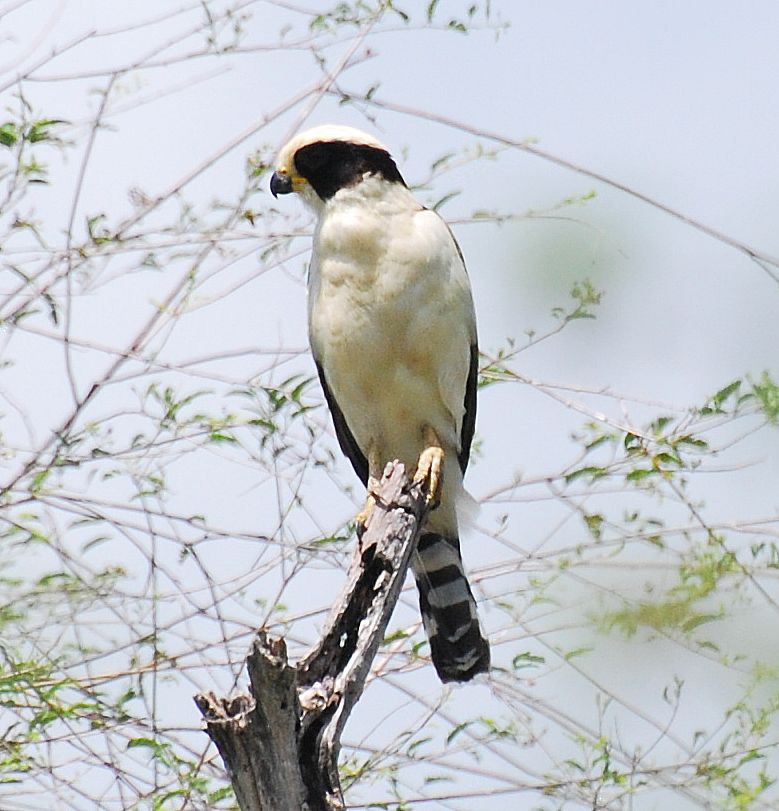
To herald the new year, I’m choosing a forceful bird of prey, one that I’ve seen a handful of times, always at a fairly great distance, and so even with my zoom, I never got a respectable shot of my own.

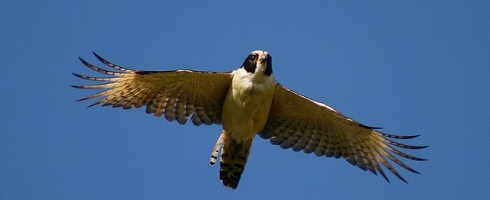
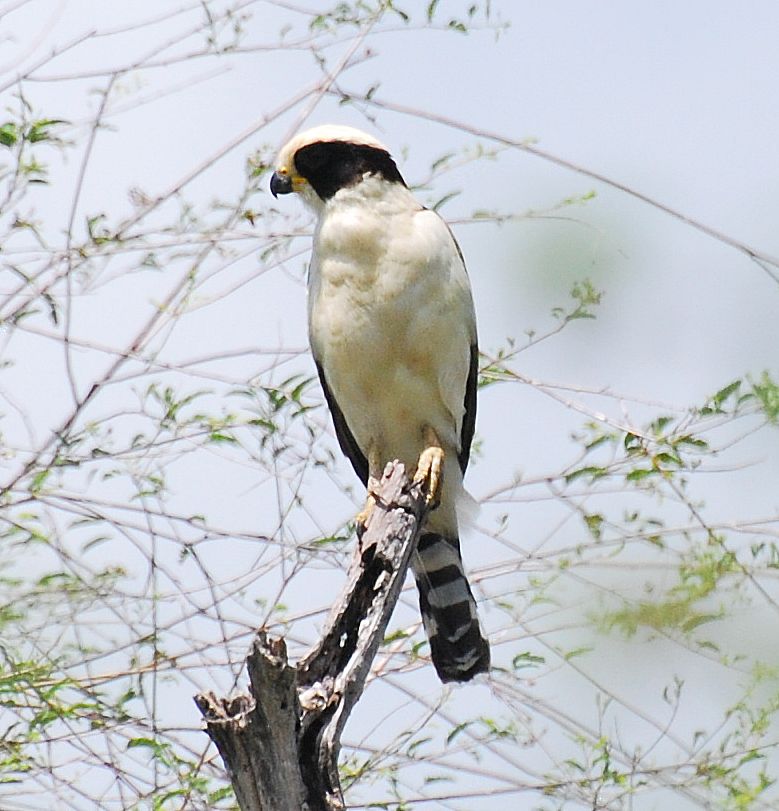
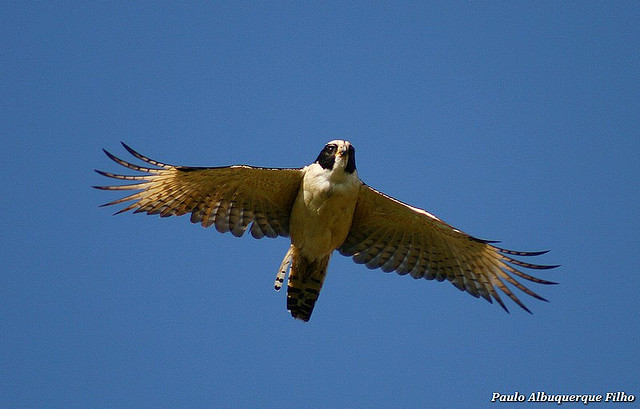
The Laughing Falcon, Herpetotheres cachinnans, named for the peal of laughing notes that initiate its lengthy song, is a large white raptor with a striking dark mask and is usually seen perched on a high tree branch in an open area, scanning the ground below for its preferred prey, snakes. After nipping off the snake’s head, it sometimes swallows the entire body as if it were a string of spaghetti. This bird – known locally as the Guaco, an excellent paraphrase of its most common call – apparently has some immunity to snake venom.

Photo courtesy of John Medcraft

I heard the Guaco many times before I ever saw it, just like the ornithologist Alexander Skutch, to whom I pay tribute here with two excerpts from his fantastic chapter called ‘The Snake Eater’ in “A Naturalist in Costa Rica.”

“For many years, the Guaco was for me only a voice and the figure of a bird, for I had not yet learned much about its habits. It was as a voice that the hawk was most familiar; from one end of Central America to the other, in humid regions covered with heavy rain forest and among the cacti and thorny scrub of arid valleys, I had heard that loud, hollow, tirelessly reiterated wah-co, wah-co, wah-co floating over all the countryside from a bird unseen in the distance. Some have compared this call to the agonized wail of a human in pain, but to me it never suggested suffering. On the contrary, the sentiment that it stirred in my spirit was of deep and inscrutable mystery.”

Photo courtesy of Paulo Albuquerque Filho - Pantaneiro Mesmo

One more excerpt describes the proud duet of a pair of Laughing Falcons after a male brings the female a freshly caught snake:

“Promptly on her mate’s arrival, the female Guaco flew down beside him and took the serpent. Her first act was to bite its forward end, as though to make sure that the work of tearing off the head with its poison fangs had been thoroughly done by the male. Then she held the limp body against the perch and began the hymn of victory that celebrated her mate’s return with the proof of his successful hunting. First she uttered a peculiar how how how, which she varied with a slightly different note sounding like haw haw; but before long this changed to a loud wac wac wac, which she continued without interruption for at least five minutes. Meanwhile the male was tuning up with a slightly different sequence of notes. Soon he worked into his full-voiced wah-co, and the two shouted together at their loudest a triumphant paean that filled all the valley and echoed from the enclosing slopes, proclaiming to all hearers that still another serpent had fallen victim to the prowess of the hawks. Then, suddenly, the pair became silent.”

If you like this sort of writing, check out Skutch’s works.

Hear the call of the Guaco.

Watch a video showing the Laughing Falcon.

6th Bird of Christmas: Purple Gallinule

31 Dec

I mentioned in yesterday’s entry that my favorite color is yellow. Well, my second favorite color is purple… and another of my favorite water birds found in Costa Rica is the American Purple Gallinule (Porphyrio martinica). Unlike most of the birds in this series, this bird can also be found in the southeastern US, which is where I had an endearing experience that won me over as a fan for life.

Gallinules – or “swamp hens” as they are often colloquially called – are in the rail family Rallidae, and although they are almost always on the water, will rarely swim at all. They rather scramble awkwardly through thickets and tall reeds, walk on floating mats of vegetation, and will only fly short distances, somewhat weakly, with legs dangling below them. They are extremely vocal, making loud screeches, and harsh reedy peeps.

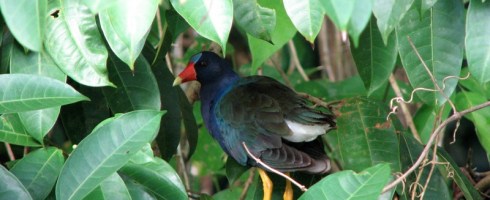
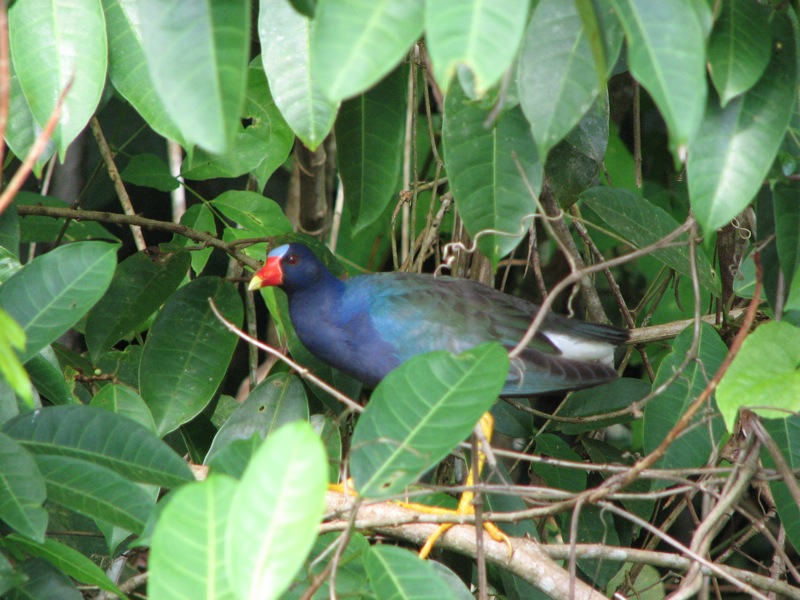
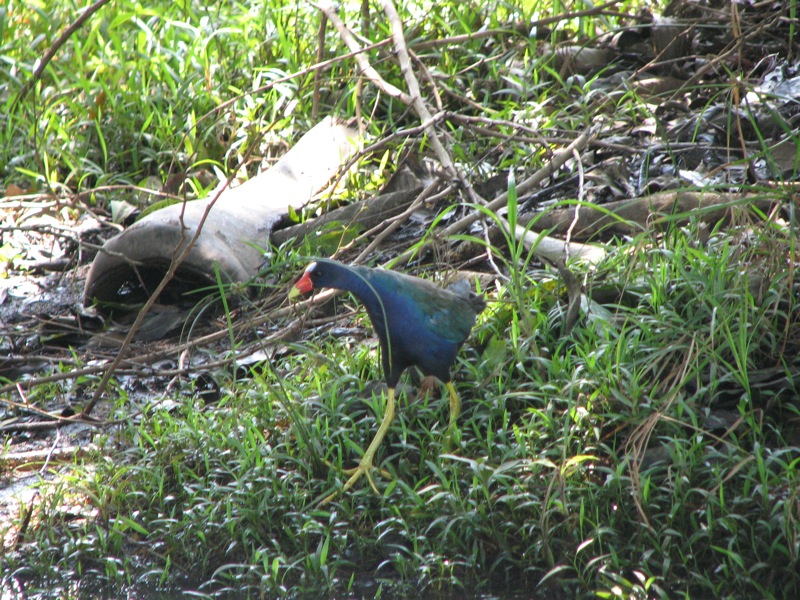
During a February in the early 2000s, my best friend from childhood and I were staying for a week at a little fishing village situated on a small lake in central Florida. We’d hike around the margins of the local marsh area every day to spot alligators, lizards and of course whatever bird life we could see. Living amid the usual egrets, herons and sandpipers, there was a noisy colony of iridescent medium-sized chicken-like birds, who had huge yellow feet, purple-blue plumage with a green back, and a red-and-yellow bill and white undertail. The coolest part of their appearance was a pale blue forehead shield, which looked like it had literally been painted onto the bird by some crazed artist. It soon became apparent that each duck-like individual had a slightly different look, hue or size of this frontal shield by which you could recognize him or her.

One of the sad results of the adaptation of wild creatures to places frequented by large groups of human beings is that certain individual animals are especially susceptible to becoming “tame” and they consequently become dependent upon people for their food – and show no fear of them. In the case of this group of gallinules, while most of the colony remained skittish upon our approach, scuttling away on little lily pads almost as if able to walk on water, one little buddy always remained quite close and would eat morsels of food right from our hands. He also called to us with an endearing “pip pip pip PEEEEEEEEEER!” We referred to this vocalization as “piping” and never forgot our little friend. In fact, when I returned to the camp a year later, I was able to locate him again!

So, when on the Caribbean coast of Costa Rica, in Tortuguero National Park, I was always elated to find my familiar Gallinule friends, although none was ever so charming or friendly as the piping gallinule of Leesburg, Florida. Just for an interesting comparison, I include below a photo of the Northern Jacana, a bird that appears very similar to the Gallinule, and has a yellow frontal shield. Like the Gallinule, the Jacana lives in marshes, ponds and other wetland ecosystems.

Not considered to be globally threatened, Purple Gallinule populations are probably decreasing in their range due to freshwater wetland loss in the United States, and in South and Central America. Sadly, these birds have been destroyed in rice fields by aerial spraying with pesticides.

Hear the vocalizations of the Purple Gallinule.

Photos in this entry by Frances Figart and Bruce Smith.

5th Bird of Christmas: Bare-throated Tiger Heron

30 Dec

As we continue exploring bird species found in Costa Rica, it’s time to look to the estuaries, lagoons and other waterways for our next two days’ subjects.

Sometimes late at night on the Nicoya Peninsula, I heard a howl that didn’t sound like a howler monkey. It sounded more like a wild cat – and I envisioned the unlikely jaguar or puma nearby.

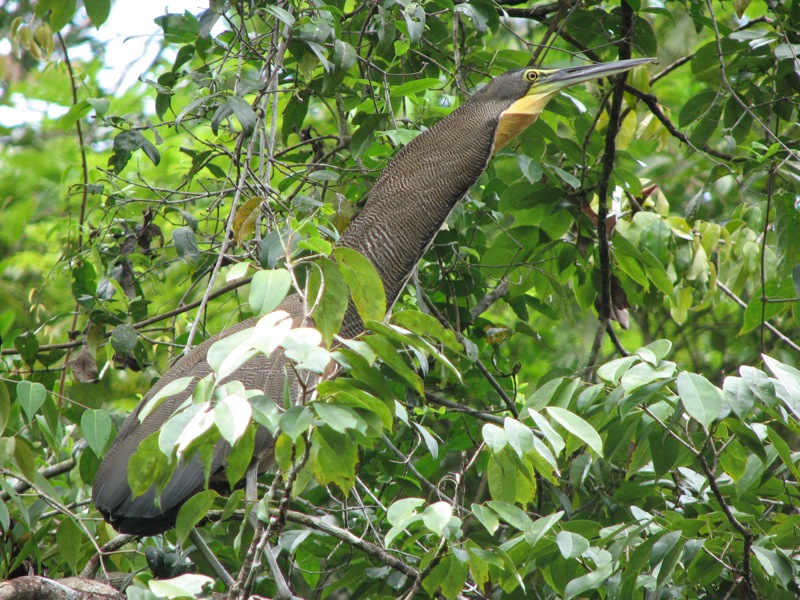
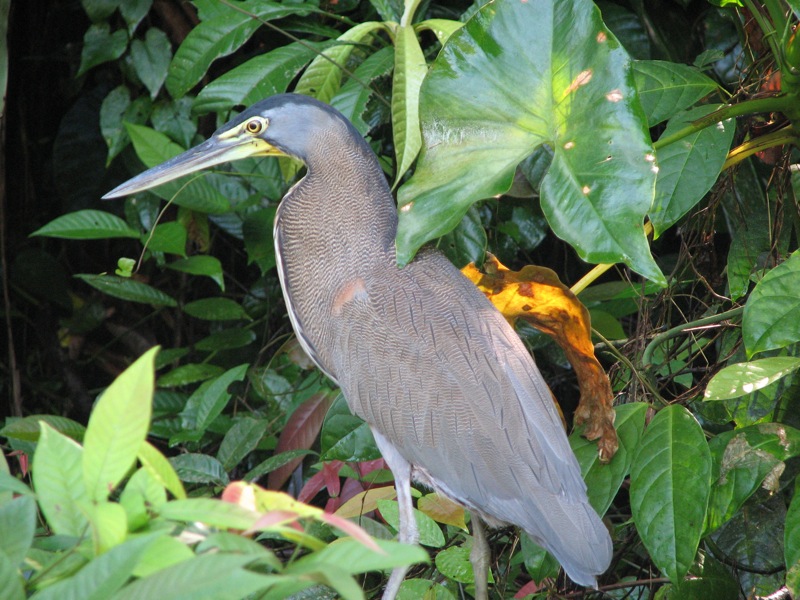
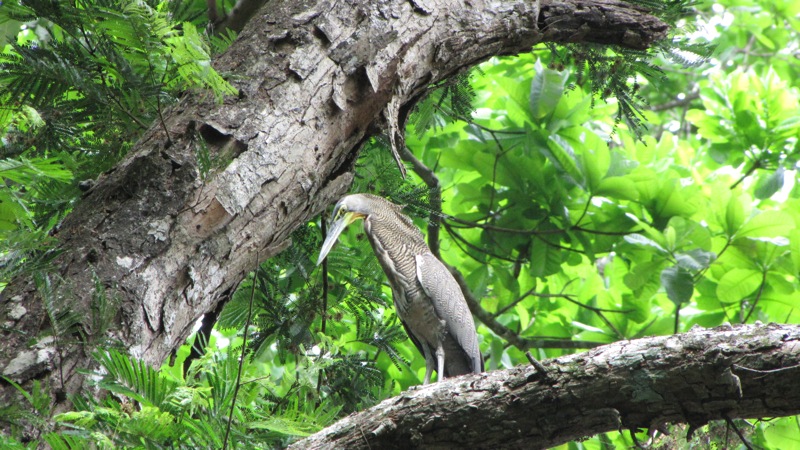
If I hiked very early in the morning on the Finca de Monos trail that wound along a tiny creek in Curú Wildlife Refuge, I could tread very lightly up a little hill on the trail, not making a sound, and upon cresting the rise, peek down over the steep bank of a the little waterway, and thus sneak up on a solitary long-legged fishing bird, waiting motionless for a fish, frog or crab to come within reach of its long bill. The strangely cat-like cry I had sometimes heard in the night belonged to this estuary ecosystem dweller, the Bare-throated Tiger Heron.

Tigrisoma mexicanum is a wading bird of the heron family Ardeidae, found from Mexico to South America; it is said there was an accidental who appeared in Hidalgo County, Texas once. At times I would come upon this shy bird while paddling along the Rio Panica, or when visiting a remote watering hole in a mountain stream with a waterfall. Since flying isn’t this heavy bird’s strong suit, it’s not too hard to photograph; it usually remains perched yet wary rather than expend the energy to retreat.

My favorite color is yellow and my name rhymes with “tiger.” So of all the herons, this bird is my favorite for its lovely tiger stripes and beautiful yellow neck, which it magically extends whist offering up its hoarse “howk-howk-howk,” making itself look unnaturally elongated. When the male emits his creature-from-the-black-lagoon night call, the beak opens wide and, if you were there watching, you’d be able to see his saffron throat actually vibrate with the sound. At other times it shrinks its neck down into its shoulders to appear very short.

And speaking of short, click here to hear a brief NPR article about some guys who heard a Tiger Heron while sitting around their campfire in Guatemala – the bird’s call is included on the tape.

Photos for this entry are by Bruce Smith and Frances Figart (rhymes with Tiger).

4th Bird of Christmas: Montezuma Oropendola

29 Dec

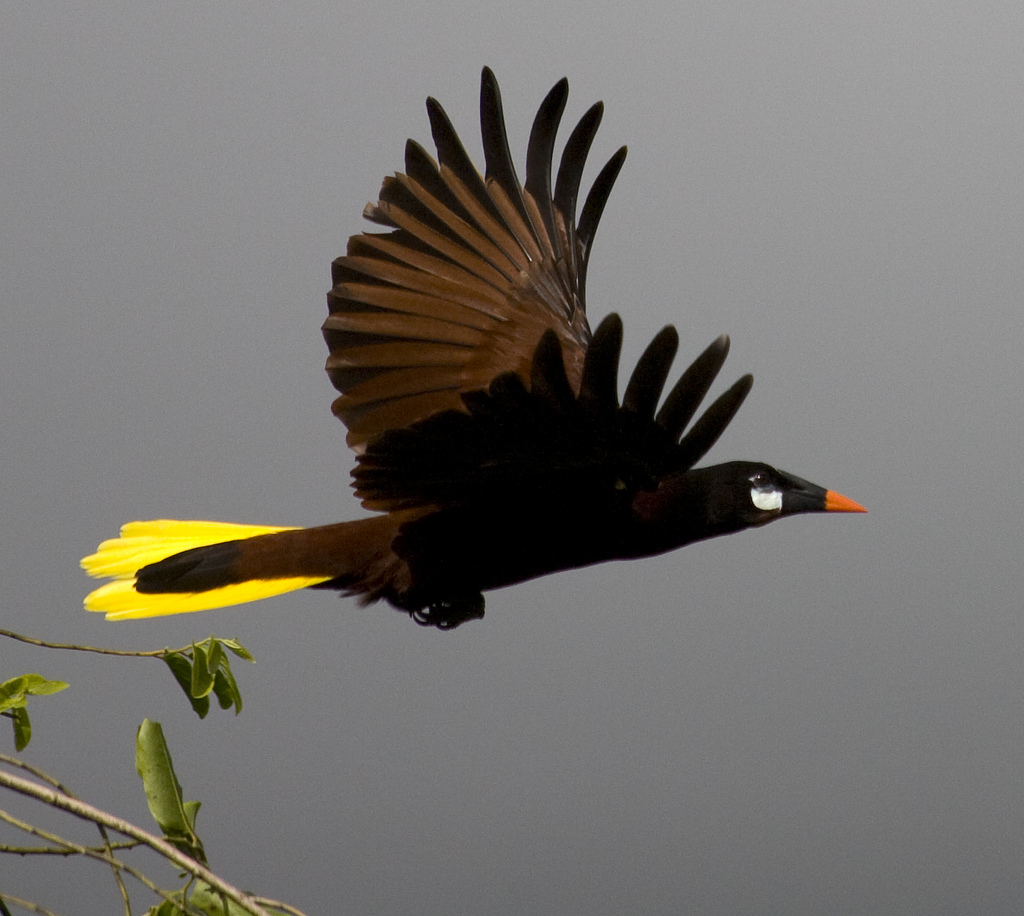
Image courtesy of Paulo Philippidis from San Jose California, USA via Wikimedia Commons.

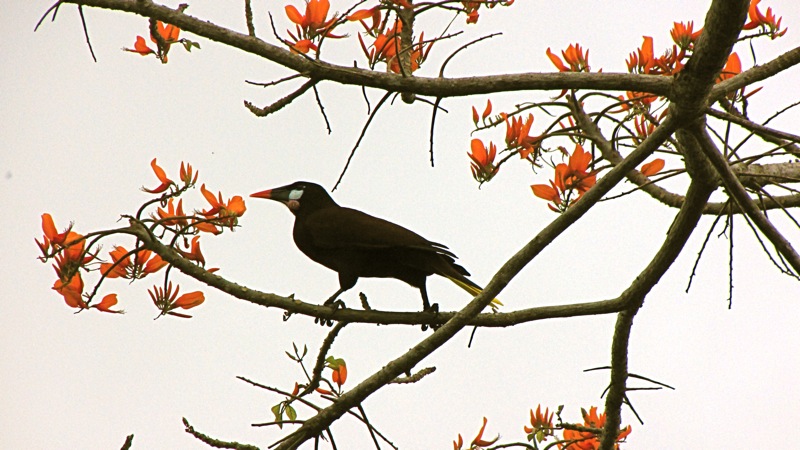
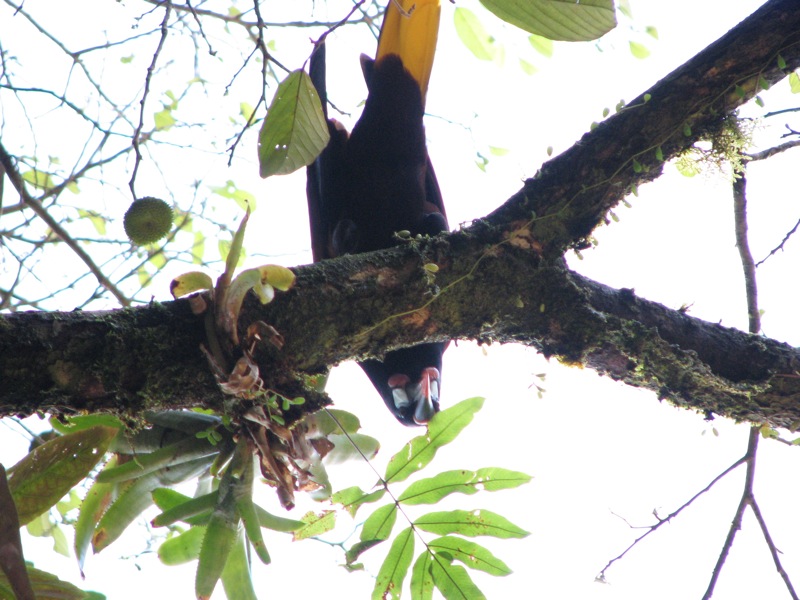
As we approach ever closer to the dawn of a new year, today’s bird is a nice one to follow yesterday’s, as both are associated with time. Just as the Motmot’s tail switches in a pendulum-like motion, so the Montezuma Oropendola does a pendulum-like somersault around a branch with its entire body, which earns it the moniker “Golden Pendulum.”

As if this crazy motion were not enough, what’s really incredible about Psarocolius Montezuma is the call the dominant male makes when he’s doing his acrobatic bowing display, sort of a bubbling warble with loud gurgles that climaxes in a shrill scream. It’s indescribable, but here’s the bird experts’ attempt: “The strange and remarkable song of the Montezuma Oropendola is an ascending series of overlapping bubbly syllables which crescendo to a high peak. The song is often accompanied by a scratchy call that is reminiscent of a fizzling firecracker or the ripping of a thick fabric (Stiles & Skutch 1989).” This bird wins my prize for the most amazing call I have ever heard. I think it would be virtually impossible for a human to emulate it.

Frances Figart

These birds are colonial breeders. Using fibers and vines, the female Oropendola creates a bag-like nest 2-6 feet long that hangs from the end of a tree branch; they like to place many nests together on the same tree. There are generally about 30 nests in a colony, but up to 172 have been recorded. The more nests on the same branch, the more risky the baby Oropendola rearing becomes because the entire colony could come crashing down from the weight. Scientists suspect the nest clusters allow the females to more easily protect each other’s nurseries and to gang up on visiting predators.

This video provides a great feel for what it sounds like to be in their presence, and shows you the pendulum-like nests made by the females. Here is another video that demonstrates the acrobatics of the male.

I got to see this bird a handful of times, mostly up in the mountains near the Turrialba Volcano, but never got excellent photographs – so I share only one of mine above. I know that my next trip to Costa Rica will be planned to include some time in the Caribbean lowlands where I can see and hear these amazing birds – and shoot some videos of them.

Photo courtesy of Bruce Smith of Seascape Kayak Tours

3rd Bird of Christmas: Turquoise-browed Motmot

28 Dec

If you are a new reader to this blog series, I’m sharing a bird species that I’ve seen in Costa Rica for each of the 12 days of Christmas (the days starting December 26 and ending Jan. 6, Epiphany). Please see the first day’s entry for more background.

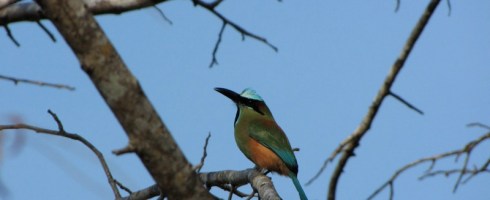
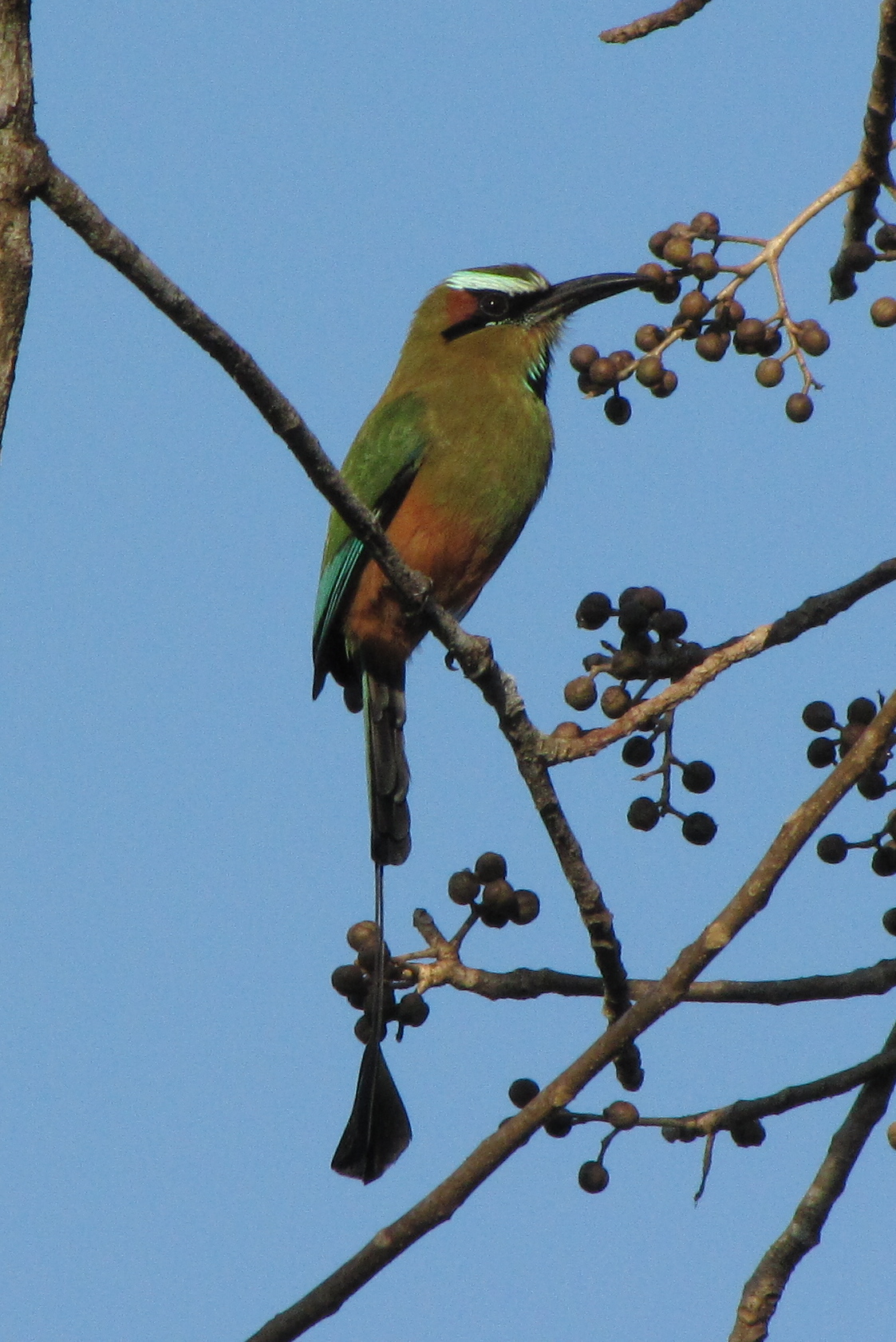
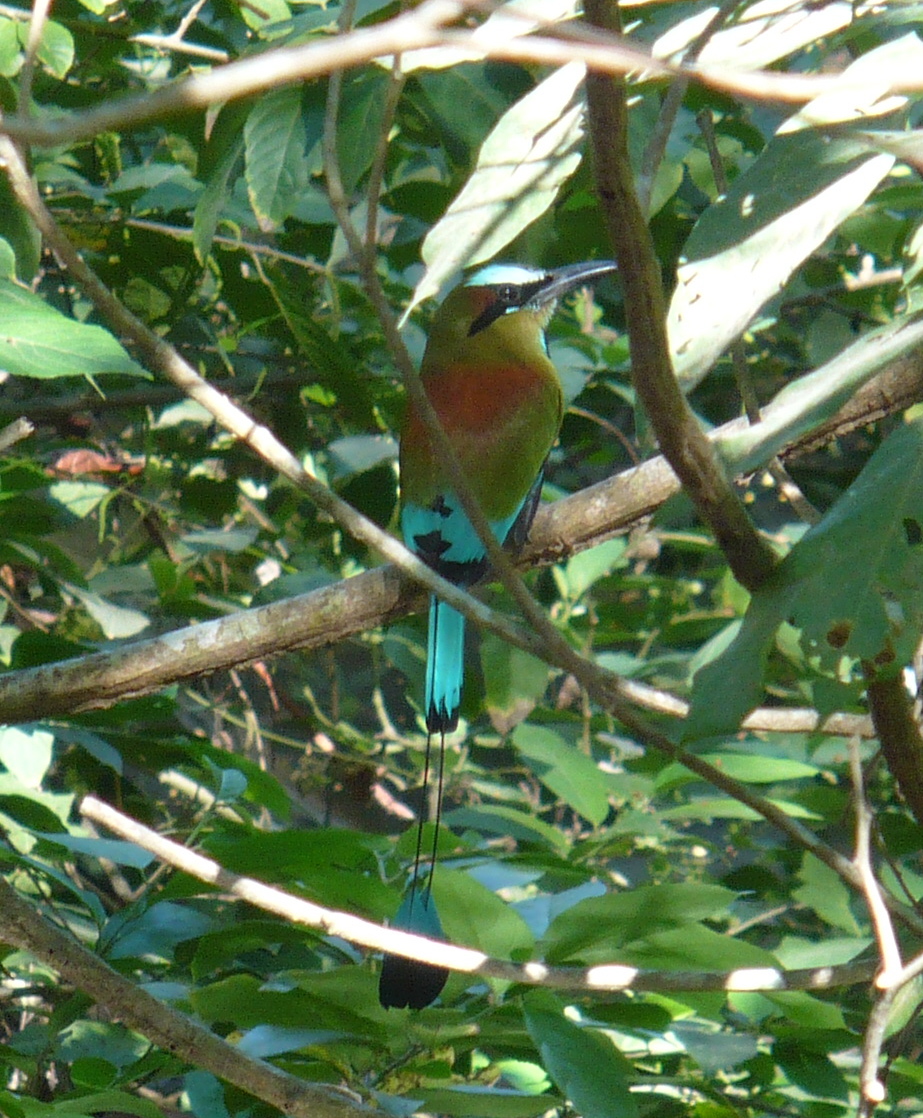
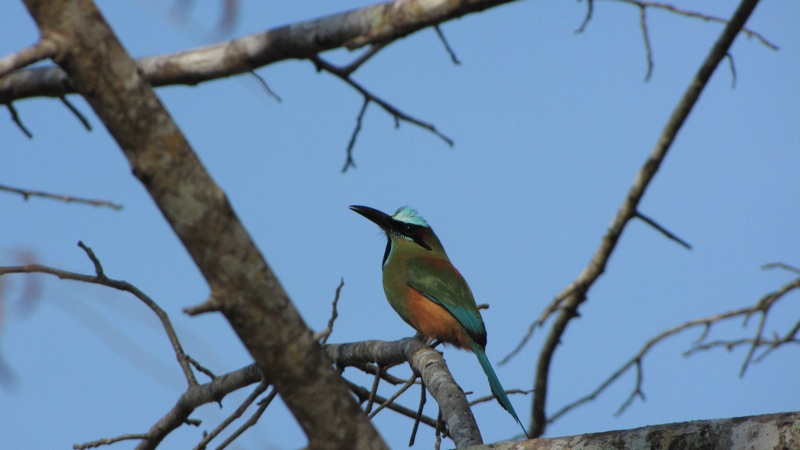
Just after I learned the trogon’s call, I quickly became enamored of the nasal croak of the Turquoise-browed Motmot. Although it is hard to play favorites with birds, this one ranks right up there and will always remain very close to my heart, partly because of its fabulous color scheme, and partly because it reminds me not to be so concerned with time. The motmot wags its tail in a pendulous motion, both to warn predators they’ve been seen and, in the male, as a sexual display. Despite this pendulum effect and its metaphorical connection to clocks, whenever I am in the motmot’s presence, I completely forget myself and am fully in the moment.

Known in Costa Rica as Momoto Cejiceleste, Pajaro Reloj (clock bird) or colloquially, the Bobo, Eumomota superciliosa is actually the national bird of both Nicaragua and El Salvador, which brings up a fact that has always dismayed me. Not to slight any avian species in the least, but of all the exotic and amazing birds that are endemic or indigenous to Costa Rica, it’s always struck me as anticlimactic that the Costa Rican national bird is…. the Clay-colored Robin!

On solitary hikes in Costa Rica, I liked nothing more than to listen for the dry monotone “wonk” of the motmot, locate it and attempt to entice it into a photo shoot. Finding it isn’t usually too much of a challenge, as it has a habit of perching on a branch in the open, or on a wire or fence, and basically showing off. Once when I took two visitors, Priscilla and Brian from New York City, for a hike in Curú Wildlife Refuge, I was able not only to find it for them, but when I made reference to its famous pendulum-like tail, the subject actually changed positions on its perch to face away from us and began to switch its tail as if on cue. The photo shown above this paragraph was taken at that moment by Brian Hoffman. Most of the photos in this entry I took early on the morning of Valentine’s Day 2010, on a high ridge near the village of Panica, where I was privileged to spend the weekend alone at the home of dear friends Juan Carlos and Yorleny.

Although it is often said that motmots pluck the barbs off their tail to create the racketed shape, this is not true; the barbs are weakly attached and fall off due to abrasion with substrates and with routine preening. Folklore has it that other birds plucked the feathers off of the motmot’s tail because they were jealous of its beauty. Those who follow The Colbert Report may recall that on February 1, 2007, the Turquoise-browed Motmot was named by Stephen Colbert as the fifth most poetic bird. I couldn’t agree more.

Listen to the motmot’s call.

More great pictures of the motmot.

Photos for this entry are by Frances Figart, except where noted.

2nd Bird of Christmas: Black-headed Trogon

27 Dec

If you are just tuning in, I’m sharing a Costa Rican bird species for each day of Christmas, the days in between the holidays of Christmas and Epiphany (January 6). Visit the first day’s entry for more background.

When I traveled to Costa Rica for the first time in January of 2008, I purposely gave the birding section of the Lonely Planet only a cursory glance. For me it is more pleasurable – and more emulative of the thrill of childhood outdoor adventure – to discover wildlife for the first time in a naïve state. It’s easier to turn off thinking and be present when you don’t know what you are looking and listening for. There will be plenty of time for reading about the creatures after you’ve had a direct experience with them “in the now.”

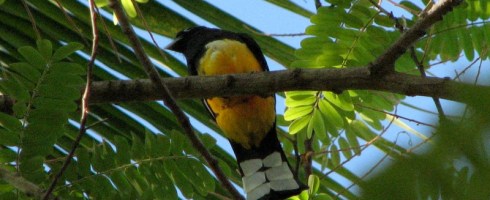
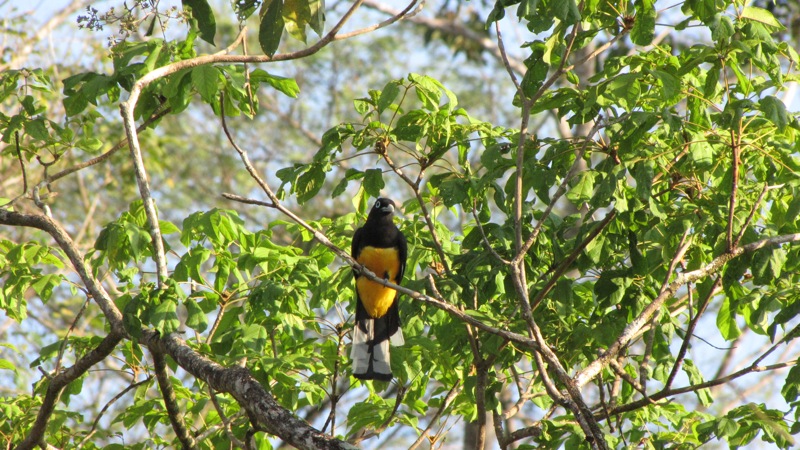
The very first day I got to go out birding, I set out at the literal crack of dawn, because that is when all wildlife is most active in the tropics. Even just an hour after sunrise, activity diminishes by about 75 percent; as the day continues to heat up, it becomes practically nonexistent. I walked along a dusty gravel road in remote Playa Naranjo on the Nicoya Peninsula, listening and scanning for movement in the trees with binoculars. Rising to the surface of the general cacophony of industrious morning calls was a song comprised of an accelerated series of whistled clucks that descended progressively in pitch. “Po-po-po-po-po-po-po-po-po-po-po” would be answered by a slightly lower, less resonant but similar call. It was easy to pinpoint where the sound was coming from, and I quickly located a pair of yellow bellied birds with excellent posture, blue rings around their black eyes, and tails that hung way down below them on their perches, sporting neat rows of white tips. They sat in close proximity to one another on different branches of the same tree, calling back and forth.

I later read this description of Trogon melanocephalus by the quintessential Costa Rican naturalist Alexander Skutch: “Often heard, too, in the shrinking Guanacastecan woodlands is the accelerated rattle or roll of the Black-headed Trogon… in March, I found seven of [them] noisily engaged in the business of forming pairs… they pursued one another through the tall forest, pausing to call while perching close together. The females’ calls were lower and drier than the males’. Like the parakeets, these trogons often dig their nest chamber in the heart of a hard, black arboreal termitary.”

After a few months in the country, I learned to easily pick out the call of the “Trogoncita” and to be able to direct others new to Costa Rica to the places where they could view the Trogón Cabecinegro. When pairs would happen onto the hotel property I later called home further down the Pacific Coast, Tambor Tropical, several of us would inevitably pause in our work and find one another in the gardens, necks stretched back, chins and eyes lifted to the high branches, where we would view the precious golden visitors, who sometimes brought their fluffy young, teaching them to fly to our great amusement.

Click here to hear the trogons.

Here is a really great photo of the Black-headed trogon.

Photos for this entry by Frances Figart and Bruce Smith

1st Bird of Christmas: Scarlet Macaw

26 Dec

The 12 Birds of Christmas

Unless you’ve grown up in Andalasia, you know that “The Twelve Days of Christmas” is an English Christmas carol that enumerates a series of increasingly grand (and in some cases improbable and quite unwieldy) gifts given on each of the twelve days of Christmas. The dozen days in the song are the twelve days starting, in some traditions, the day after Christmas and leading up to the Feast of the Epiphany (January 6).

While I’m enjoying (forces smile) a prolifically snowy and more-often-than-not-below-effing-freezing Christmas holiday in the states, tropical climes are, as you can imagine, not far from my mind. Having spent a great deal of the winter time in Costa Rica the past few years, I have many favorite bird species there. I decided to share here 12 of them, some of which I have actually sighted and photographed – and a few who continue to elude me – offering up a let’s-pass-some-time-doing-something-productive-and-educational blog series: The 12 Birds of Christmas!

Dec. 26: The First Bird of Christmas is the Scarlet Macaw

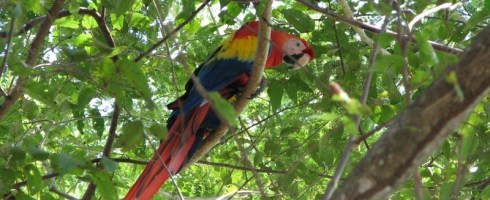
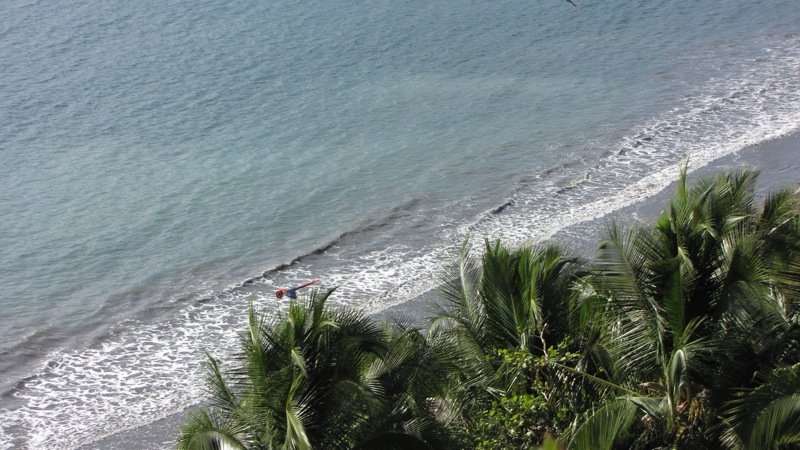
Jogging along in the sand as the tide goes out along Playa Tambor, I’m distracted by what sounds like a raucous argument between two domestic partners. I follow the animated chatter away from the Pacific and up towards the estuary that flanks the tiny air strip next to a popular Vegas-like resort that is all some know about the sleepy fishing village of Tambor. As I get closer, I recognize the combatants’ voices. They belong to Scarlet Macaws, who make roaring vocalizations whilst flying from their roost to a feeding site, and then wax relatively quiet when munching on a perch, which they’ve just found.

At one time, the beautiful large, bright red-blue-and-yellow Ara macao was close to extinction due to the pet trade and the destruction of habitats that include their main source of food, Tropical Almond (Terminalia catappa) trees, on which this pair is feeding somewhat noisily. Our area on the Nicoya Peninsula is one the places where conservation efforts – including nest protection, artificial nest creation, captive breeding-and-release and reintroduction programs such as the one at Curú Wildlife Refuge – have contributed to the successful comeback of the Lapa, as it is known to Ticos (Costa Ricans).

The illegal exotic pet trade is an industry that disturbs me greatly; sometimes while hiking in Costa Rica I have seen youngsters with nets attempting to capture birds. Parrots, iguanas and wild cats are the animals most often exploited. Now, on the rare occasions that I enter a pet store in the states where I see some of the parrots and macaws that I have adoringly followed in their natural habitats, I am sickened and outraged that this torturous practice continues to flourish. At some point in my future, perhaps there awaits a project to raise more awareness about this issue. If you have been involved in a good program to combat the pet trade, I’d love to hear about your experience.

One bird down, and 11 to go.

Listen to a clip of the Scarlet Macaw.

Photos for this entry by Frances Figart


Yoga retreat at New Years on an island in Nicaragua, anyone?

24 Nov

Nicaragua, the next big ecotourism destination

In recent years, as social stability and economic growth have come to Central America, travelers with a taste for the cutting edge are discovering that Nicaragua is one of the undiscovered treasures of the Western Hemisphere. Visitors to this country will find that tours, accommodations, food, activities and transportation are affordably priced. And perhaps an even more important distinction, locals are truly authentic and welcoming. The interactive traveler who likes to be the first to discover a new destination and actively engage with the locals, knowing that their visit to the country is giving back directly to the community, will love Nicaragua. And it is only a two- to three-hour flight from Miami (American), Atlanta (Delta) and Houston (Continental) into the capital city of Managua, and no visas are required.

Nicaragua’s newest eco-resort, Jicaro Island Ecolodge is managed by the award-winning Cayuga Sustainable Hospitality and was created to capture the country’s true essence.

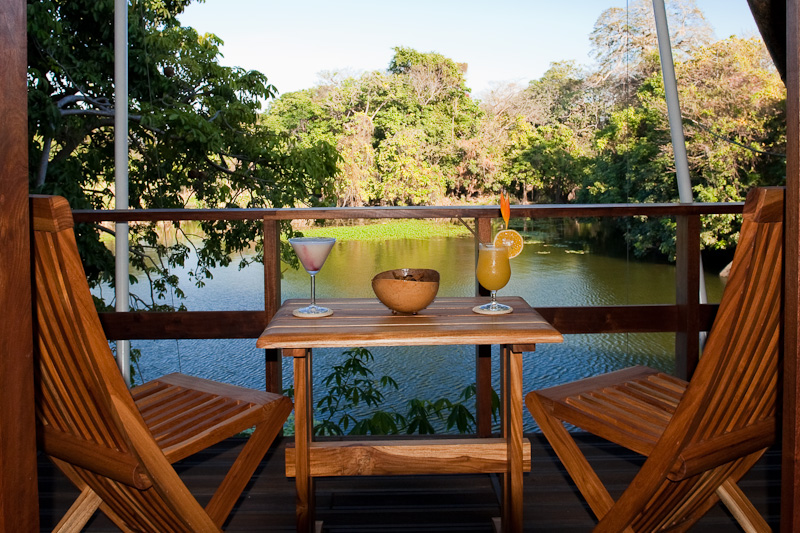
Set on a private island, the eco-luxury lodge opened in January 2010 and is located just a short boat ride from the colonial town of Granada, Nicaragua’s top tourist town. Designed by internationally acclaimed architect Matthew Falkiner, the lodge offers nine two-level and very private casitas, hand crafted using indigenous wood. There is a floating yoga platform (shown above), gorgeous lounge areas and pool. Meals are created using seasonal, local ingredients, and highlight Nicaraguan recipes and flavors. Jicaro Island offers spectacular views of the Mombacho Volcano across Lake Nicaragua and over 100 different species of birds have been sighted since opening.

Jicaro Island Ecolodge is also quickly gaining a reputation for its yoga and wellness retreats, of which four are scheduled for the very near future in partnership with Big World Small Planet. I recently had the opportunity to interview the leader for the first of these, Peter Sterios, the founder of Manduka, a company providing high-quality yoga mats and other accessories, who will be offering Gravity & Grace: Resistance As Your Inner Teacher December 29, 2010-January 4, 2011.

Interview with yoga instructor Peter Sterios

Peter lives and teaches in San Luis Obispo, CA. His classes reflect over three decades of study and practice in the US and India. A writer and former contributing editor for Yoga Journal, he has been featured in their yoga calendars, Beginners Column, Master Class Column and web site. He has taught at numerous yoga conferences, and continues to conduct workshops and teacher trainings throughout North and Central America, Asia, and Europe. He founded Manduka, a leading eco-yoga products company in 1997. His first yoga DVD “Gravity & Grace” was released in 2007 and recently honored by Yoga Journal’s Richard Rosen as “one of the top 15 yoga videos of all time.”

Frances: When you were young, what did you think you would be when you grew up?

Peter: A pilot.

Frances: What early interests, studies and career choices led you toward your current focus?

Peter: I ended up in architecture school because of an intense fascination with LEGOs from about the age of 4. I liked creating things, building things, and ultimately learning how structure works in buildings and then eventually in bodies as a yoga teacher. It was a roundabout journey though from architecture school to India to study yoga. Once yoga entered my life for real, I sought out teachers and places to study to understand the roots of the practice in an effort to simplify the instruction and make it more accessible to beginners. As a result, I’m now a yoga teacher, a writer, an architect, and a yoga product designer for Manduka which I founded in 1997.

Frances: What types of yoga instruction do you focus on most specifically?

Peter: Yoga for those with healing “opportunities” – people who have a health condition that requires their personal involvement to deal with it successfully.

Frances: What is your philosophy of yoga instruction, in a nutshell?

Peter: Get out of the way of the student’s own experience of the practice so they can uncover the “inner teacher” for themselves.

Frances: Explain your use of “resistance” as an “inner teacher.”

Peter: Resistance is a spot or place in the body that communicates to the mind that more attention is required there. Once you learn the language the body uses to send that message, your practice is just listening to what is needed at that spot.

Frances: What can guests expect from working with you in a luxury eco-retreat setting like Jicaro?

Peter: Lots of rest, a little sweat, lots of breathing, lots of laughing, and more rest… oh, did I mention amazing food?

Frances: Do you like to work with people who are advanced in practice or new to yoga, or both?

Peter: I prefer to work with anyone with a desire to learn more about themselves, experienced or beginners. Frankly, there isn’t much difference between the two when it comes to learning about the power of the mind to create your own self healing.

Frances: Why are you excited about coming to Nicaragua for the New Year and this retreat adventure?

Peter: Lots of rest, a little sweat, lots of breathing, lots of laughing, and more rest… oh, did I mention amazing food?

Frances: Ha, nice repetition! As a former contributing editor to Yoga Journal, have you always enjoyed writing and communication?

Peter: Yes, but I enjoy it more after the deadlines, when the articles are finished. The writing process for me is always a test, and I struggle with finding the minimum amount of words to get across what I want to say.

Frances: Well, I think you have succeeded in being both succinct and articulate. Thank you for your time!

Peter: Thanks for getting the word out for this retreat. Adrienne at Big World Small Planet has done an amazing thing creating the setting and the opportunity for all of us to have a little adventure this New Year’s. What better way is there to start 2011!

For detailed retreat information and registration, click here.

More Upcoming Retreats at Jicaro Island

January 8 – 14, 2011. Celebration of Nia & Wine with Mona Melms. Nia is an innovative workout integrating 9 movement forms based on dance arts, martial arts and healing arts, inspiring you to find tremendous joy in moving your body…barefoot…in the tropics!

January 29 – February 4, 2011. Real Wellness with Alycea Ungaro. This highly experiential week integrates a diversity of modalities and practices focusing on Alycea Ungaro’s Six Principles of Wellness while studying and enjoying Pilates, nutrition and the surrounding nature.

February 5-11, 2011. livWHOLE with Jennifer Galardi. Many of us have been operating on automatic; eat, work, gym, sleep, rinse, repeat. Jennifer guides each participant to take a look at wellness as a whole instead of the sum of its many parts.

Photos of Jicaro Island Ecolodge by Martin van Doorn, courtesy of Cayuga Sustainable Hospitality and StoryTravelers.

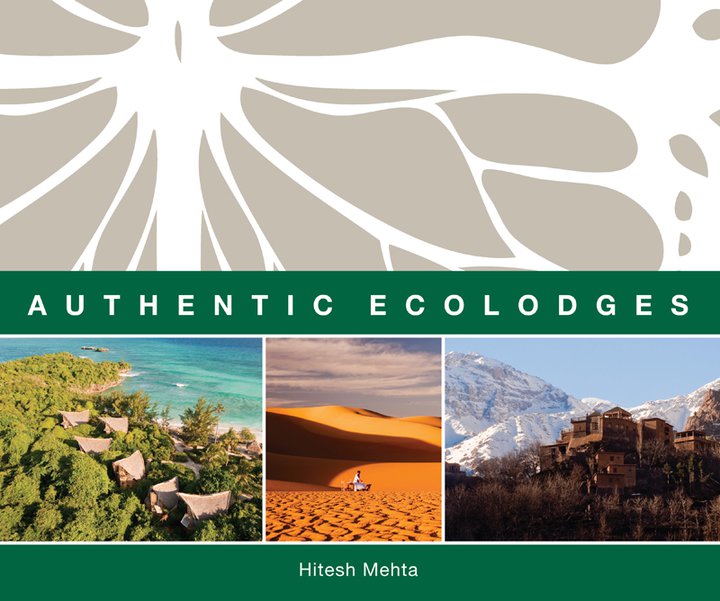
Hitesh Mehta and Authentic Ecolodges

15 Nov

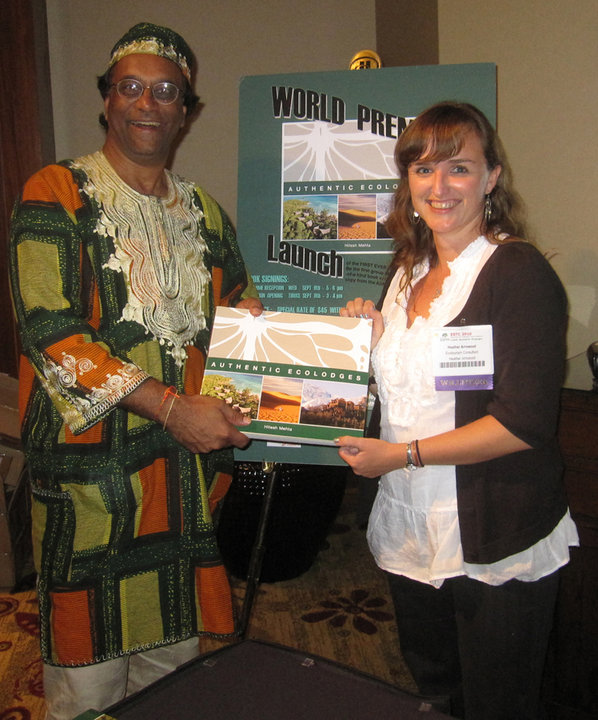
Originally published earlier this month as a blog for Cayuga Sustainable Hospitality and Lapa Rios Ecolodge, this recent interview with my friend Hitesh provides a fascinating glimpse into the life and work of a unique travel professional who has written a compelling new book (which he refers to not as a “coffee table” book but as a “chai table” book), perfect for a holiday gift for anyone of any age who loves to read about the sustainable designs of exotic, eco-friendly lodgings and see state-of-the-art photography of amazing architectural spaces from all over the world! Order Authentic Ecolodges here.

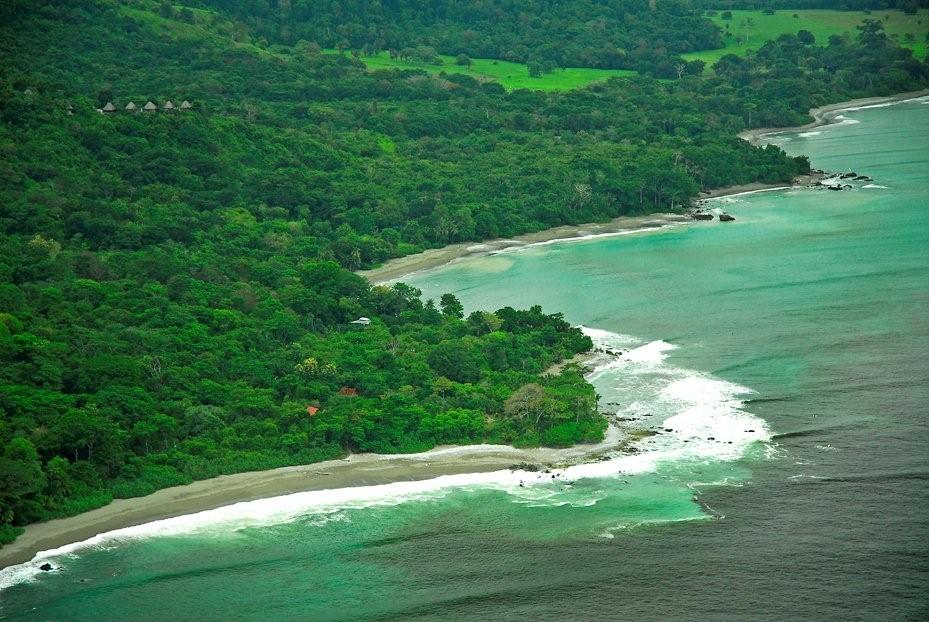
Lapa Rios Ecolodge on Costa Rica's Osa Peninsula


“Nestled between the Pacific and one of Central America’s last remaining lowland rain forests, Lapa Rios is a true tropical paradise, graced with a dazzling array of biodiversity and dramatic scenery. A Minnesota couple, Karen and John Lewis, purchased the land in 1991 with the intention of proving a point: that a rain forest left standing is more profitable than one cut down… Committed to the idea that the land could be sustainable in both economic and ecologic terms, the Lewises constructed Lapa Rios around the rain forest (instead of the other way around)… It is one of only three properties in the whole of Costa Rica that has earned the highest possible ranking—five green leaves—under the Certification for Sustainable Tourism (CST).”

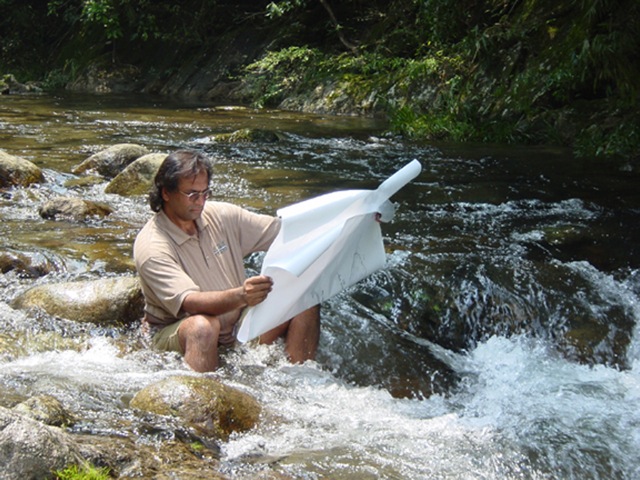
Thus begins the Lapa Rios section of Hitesh Mehta’s new book, ‘Authentic Ecolodges,’ published in September and launched worldwide earlier this month with an array of book signings and other events scheduled for the next few months on several continents. Hitesh Mehta, world-renowned landscape architect, environmental planner and architect, is one of the world’s leading authorities, practitioners, and researchers when it comes to ecolodge planning and design from both the architectural and landscape architectural perspectives. Through his design work with indigenous communities, Mehta has developed a portfolio of projects in Madagascar, Egypt, China, Saudi Arabia, India, Kenya, Uganda, Rwanda, DR Congo, Turks and Caicos, Galapagos, Gabon, Fiji, Bahamas, St. Vincent and the Grenadines, Puerto Rico and the United States. His latest accomplishment, a one-of-a-kind experiential book, is the product of a 2 ½ year, 46-country, six-continent journey to document and illustrate what truly makes an ecolodge an ecolodge.

Frances: You are obviously overjoyed to have reached the milestone of having your amazingly beautiful and immensely educational book finally published by Harper Collins. Tell us more about your vision for the book and why you undertook such a vast and awe-inspiring project.

Hitesh: There are two main reasons I have done this book: to create both environmental and social awareness amongst people around the world and to celebrate the fantastic and altruistic work of people on the ground – such as craftspersons and lodge owners. As you know, I created my own rating system for ecolodges, which is explained in the book, and I sifted through 24,000 of my own professional photographs to pick just over 300 for this book. The feedback I am getting from people in-the-know is that it is the most all encompassing and holistic book ever created in the hospitality industry. In addition to stunning photos, there are professional illustrations, site plans and text that has substance for the lay person and industry professional alike. And it is printed on environmentally friendly FSC certified paper. Harper Collins is so excited that they want to submit the book for an award!

Frances: In addition to 35 other ecolodges, the book features Cayuga Sustainable Hospitality’s own Lapa Rios. Why do you consider Lapa Rios a model ecolodge?

Hitesh: Lapa Rios was one of few ecolodges in the world that met 10 out of 11 criteria. There are no ecolodges to date which have met ALL the criteria including the ones that I have personally worked on. Lapa Rios is especially strong in the three main criteria: that of protection of the surrounding ecosystem, helping benefit local communities and providing a rich interpretive experience. The one criterion that it does NOT meet is the one where “ecolodges bring in the local communities from day one of the planning and design process.” What gives it its special ambiance is that it has been led by visionaries (Karen and John) for the past 18 years and managed by the top small eco-chain (Cayuga) in the world. The other unique aspect of Lapa Rios that sets it apart from other ecolodges is its commitment to an exit strategy.


Habitation with ocean view at Lapa Rios Ecolodge


Frances: You have been involved in ecotourism for a very long time, since the beginning really. What new trends do you see influencing decision makers and stakeholders in ecolodge development?

Hitesh: One new direction is the idea of community owned and operated ecolodges. This concept started in Kenya but now has spread all over the world. These are projects which are entirely owned and operated by the local communities, such as Maasai and Native Americans in the Bolivian Amazon. A second interesting trend is that more and more ecotourism enterprises are adding “wellness centers” to their program of offerings. Yet another is the expansion into higher quality lodges. The upgrading of facilities is a response to the growing upper middle-class ‘experience seekers’ and ‘metro-spirituals’ market.

Frances: Why did you choose to study ecotourism and why do you love it?

Hitesh: Ecotourism is low-impact, practices non-violence principles and, as a sector of the tourism industry, has played a role in alleviating poverty in several rural parts of the world. It is the one sector of the tourism industry that has the greatest respect for both faunal and floral species as well as the welfare of the local people. Everything in the landscape is inter-connected and dependent on each other. The flowers are dependent on the butterflies and bees, the fruit dependent on the flowers getting pollinated, the birds and monkeys dependent on the fruit, the eagles and leopards dependent on the monkeys etc. Every single species is connected in this web of life. As humans, we are dependent on so many things—not only those that are man-made but those things that come from nature. If the natural web-link is destroyed by humans then our own existence will be in peril. In fact, it already is!


Frances: This touches on the concept you have talked to me about before, that of ecopsychology. Could you explain this for our readers?
Hitesh: In very simple terms, ecopsychology connects psychology and ecology. The basic idea of ecopsychology is that while the human mind is shaped by the modern social and technological world, it can be readily inspired and comforted by the wider natural world, because that is the arena in which it originally evolved. The political and practical implications are to show humans ways of healing alienation and to build a sane society and a sustainable culture. Mental health or unhealth cannot be understood simply in the narrow context of only intrapsychic phenomena or social relations. One also has to include the relationship of humans to other species and ecosystems. The destruction of ecosystems means that something in humans also dies. Humans, whether they know it or not, whether they like it or not, are part of this web and linked intrinsically with all species of nature. If they destroy nature, they will eventually destroy themselves.

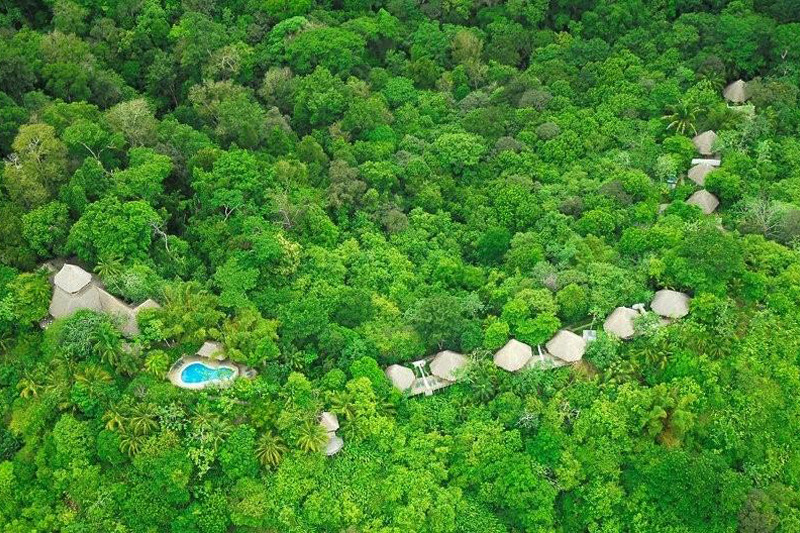
Another aerial view of Lapa Rios Ecolodge

Frances: How does Lapa Rios fit into the ecopsychology concept?


Hitesh: Being located in one of Costa Rica’s most biodiverse areas comes with a list of environmental responsibilities—namely protecting the area and its inhabitants. Lapa Rios works with the Nature Conservancy and Cederena to ensure that protective measures are in place. On any given day, guests can watch an impressive range of animals—troops of howler monkeys, long-nosed coatimundis, three-toed sloths, and over 320 species of birds, like scarlet macaws and toucans frolicking in their natural habitat—all of which is visible from one of the lodge’s sixteen open-air bungalows. During construction, not one native tree was cut down to yield the five-acre compound. Lapa Rios is one of the Osa Peninsula’s largest employers: 90 percent of its sixty employees are from the local community. This is all in the book – and to learn the rest, you have to read it!


Frances: What can we as professionals in the hospitality and tourism industry do to help spread the word about ‘Authentic Ecolodges’?

Hitesh: Since no man can be an island, I look for your support to hand over this book as a gift to as many people as you feel will benefit. This will also make your holiday season stress-free as you won’t need to worry about what gifts to give! The more books you buy, the more we will all collectively be able to make a difference on this planet!

Order the book here.

Watch a short video about Authentic Ecolodges

Upcoming book signings with Hitesh:

Seattle:  Tuesday, November 16, 7 p.m. Third Place Ravenna Bookstore, 6504 20th Ave. NE, Seattle, WA 98115

Canada: Wednesday, November 17, 11:30 a.m. Tourism Victoria, 4th Floor, Bastion Square, Victoria, BC

Los Angeles: Friday, November 19, 7 p.m. Borders Westwood, 1360 Westwood Blvd, Los Angeles, California 90024

Irving: Sunday November 21, 4 p.m. Element Hotel, 3550 W. IH 635, Irving, Texas 75063

South Africa: Saturday, Dec. 4, 3 p.m. Book Dealers of Gallo Manor, Lower Level, Morning Glen Shopping Center, Corner of Bowling Road and Kelvin Drive, Gallo Manor, phone (o11) 656.7026

Africa: Saturday, December 11, 4 p.m. Text Book Centre, Sarit Centre, Westlands, Nairobi, KENYA

More about Hitesh Mehta

A professional photographer and Hall of Fame cricket player from Kenya, Hitesh Mehta was named one of the “25 Most Powerful People in Adventure” by Men’s Journal. He is an adjunct professor at several universities in southern Florida, sits on the board of The International Ecotourism Society, is a member of the advisory board of BIOSFERA (Brazilian Environmental Society), is a founding member of The Ecotourism Society of Kenya, and has been the international advisor for the Japan Ecolodge Association. He has also been a judge and on-site inspector for the Tourism for Tomorrow awards, World Legacy Awards on Heritage Tourism and Ecotourism (National Geographic/Conservation International) and Ecotourism Awards (Conde Nast Traveler).

If you have enjoyed this interview, some of the topics touched on are discussed more in depth in another interview with Hitesh by Meg Pier, here.